Sage Plays Role In Two-Tier ERP Strategy
Sage's portfolio offers multinationals a way to standardize local applications, according to Forrester. This approach may help companies balance global consistency with local needs.
Original reporting · forrester.com
Original: “Two-Tier ERP Is Back, And Sage Has A Role To Play”
Read “Two-Tier ERP Is Back, And Sage Has A Role To Play” at Forrester →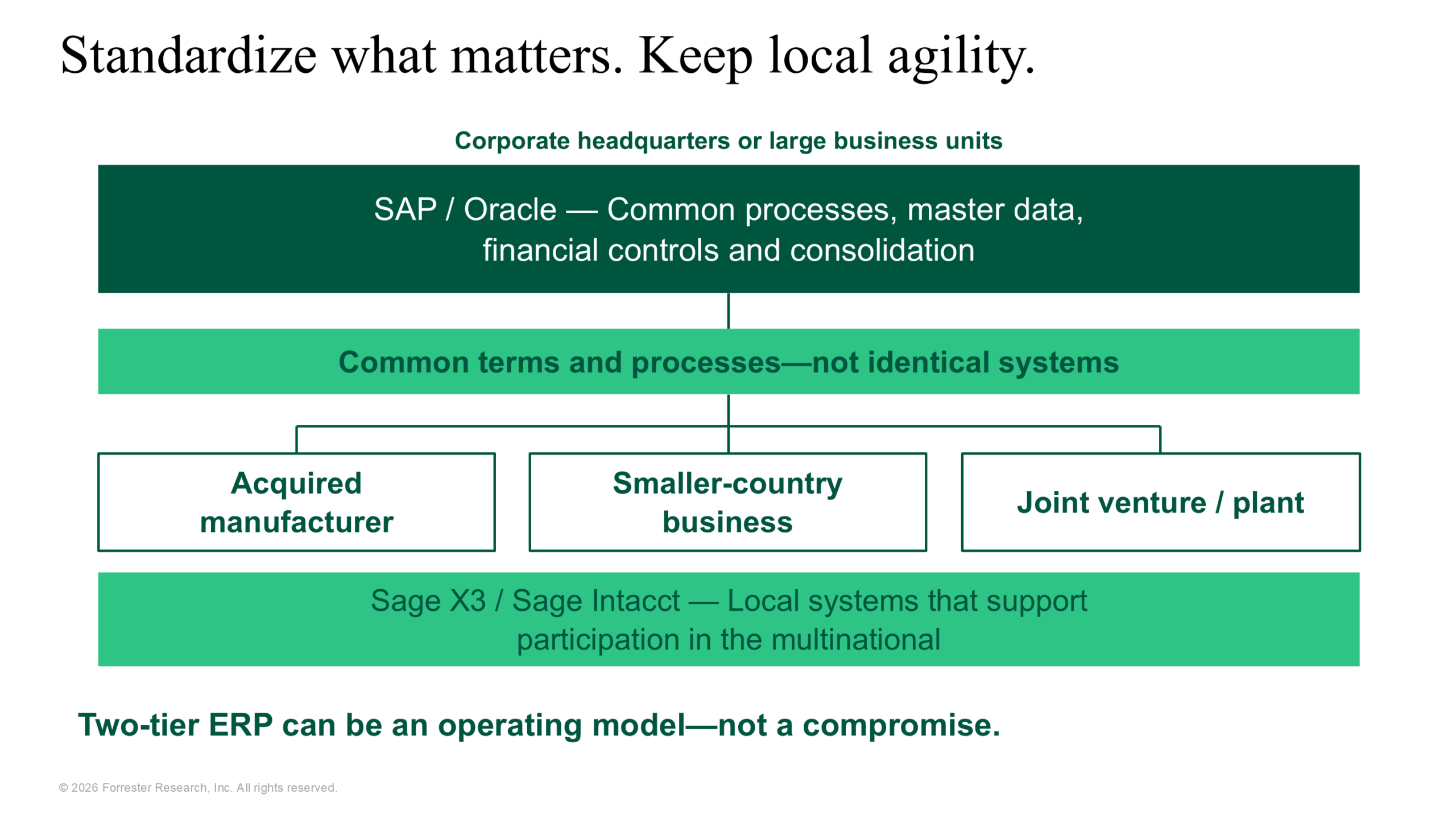
How this was written. ABM Fuel wrote this article with a language model from Forrester’s reporting (model: @cf/meta/llama-3.3-70b-instruct-fp8-fast); it describes that reporting rather than adding to it. The original, linked above, is the full story.
Key points from Forrester’s report
- Sage's portfolio may be well-suited to support two-tier ERP strategies, which allow larger companies to maintain standardized systems at the corporate level while accommodating the needs of smaller subsidiaries.
- The ability of Sage X3 and Intacct to complement larger ERP systems makes them relevant to multinational companies.
- A thoughtful and nuanced approach to ERP is necessary to balance global consistency with local flexibility.
- Multinational companies should consider which processes and systems need to be standardized and which can remain local when acquiring smaller businesses.
Forrester reported that multinational companies often struggle to balance standardization with the unique needs of smaller operating businesses. A company may have a standardized system at its corporate center, but its smaller subsidiaries may have different requirements. This can create complexity when it comes to managing enterprise resource planning (ERP) systems.
The idea of two-tier ERP is to allow larger companies to maintain a standardized system at the corporate level while also accommodating the needs of smaller subsidiaries. This approach recognizes that not all businesses within a multinational company need to be on the same system. According to Forrester, Sage's portfolio, including Sage Intacct and Sage X3, may be well-suited to support this type of strategy.
When a multinational company acquires a smaller business, it may not be necessary to immediately migrate the smaller business to the parent company's ERP system. In fact, doing so could disrupt the smaller business's operations and potentially harm its value. Instead, the parent company should consider which processes and systems can remain local and which need to be standardized.
Sage X3 and Intacct may be able to complement larger ERP systems, rather than competing with them. For example, a company that uses a tier-one ERP system at the corporate level may still use Sage X3 or Intacct for smaller subsidiaries or joint ventures. This can provide the smaller businesses with the functionality they need while also allowing them to participate in the parent company's common processes and systems.
The ability of Sage X3 and Intacct to support two-tier ERP strategies makes them relevant to multinational companies. These companies often need to balance global consistency with local flexibility, and Sage's products may be able to help them achieve this balance. By providing a standardized system that can still accommodate local needs, Sage may be able to help multinational companies streamline their operations and improve efficiency.
Forrester notes that this approach requires careful consideration of which processes and systems need to be standardized and which can remain local. It also requires a thorough understanding of the smaller business's needs and how they fit into the parent company's overall strategy. By taking a thoughtful and nuanced approach to ERP, multinational companies may be able to achieve greater efficiency and effectiveness.
Questions and answers
What is two-tier ERP?
Two-tier ERP is an approach that allows larger companies to maintain a standardized system at the corporate level while also accommodating the needs of smaller subsidiaries.
How can Sage's products support two-tier ERP strategies?
Sage X3 and Intacct may be able to complement larger ERP systems, providing smaller subsidiaries with the functionality they need while allowing them to participate in the parent company's common processes and systems.
What are the benefits of using a two-tier ERP approach?
The benefits of using a two-tier ERP approach include greater efficiency and effectiveness, as well as the ability to balance global consistency with local flexibility.